
You probably know someone who has never taken lessons and still sings well. And you probably also know someone else who has been trying for months or even years and still struggles to hit a note. The conclusion seems obvious: some are born with talent and others aren’t. But that conclusion can be misleading. The voice we hear today doesn’t necessarily reflect a person’s potential. It reflects, above all, the current state of their vocal system. Two people can start from completely different places. One may have always sung with ease, while another can barely produce a steady pitch. However, that doesn’t mean the first has more potential. In many cases, the opposite is true. So the question shifts from “What kind of voice are we born with?” to “What really determines the development of a voice?” Based on my experience working with many voices—including my own—I’ve come to the conclusion that this question is best understood if we stop thinking of the voice as a single entity and start seeing it as the interaction of various variables. In this blog post, my aim is to analyse the voice through three variables: position and flexibility, coordination, and training.
These variables do not function the same way nor carry the same weight. Each can be developed to a different degree and… depending on that configuration, lead to completely different vocal results. Understanding how they combine allows us to explain why two singers can sound extraordinary for completely different reasons and, at the same time, shed light on many phenomena that we tend to attribute solely to “talent.” Before delving into each one, there is a fundamental problem: unlike a violinist or a pianist, a singer cannot directly see their instrument. An instrumentalist can observe the position of their hands, their fingers, and their movements, and relate what they are doing physically to the sound they produce. In singing, this is not possible. The singer relies primarily on what they hear and, to a large extent, on what they feel. However, this is where one of the major problems lies in the way we typically understand and teach the voice.
Internal sensations depend on the state of the voice. Some may be common among voices with similar configurations, but they cannot be taken as universal references for any voice or for any stage of development. Two people may perform seemingly similar actions and feel completely different things. This depends largely on the position and flexibility of their vocal apparatus. Furthermore, the same person will experience different sensations as their voice changes. What feels a certain way today may feel completely different after adjusting a position or developing greater flexibility.
That’s why understanding the voice isn’t about chasing a “correct” sensation; it’s about building a map that lets you know at what stage you are, what changes to expect, and what the next step might be. In other words, sensations and what we hear can serve as a guide, but they are temporary and depend on how our voice is organized at that moment. That’s why the key isn’t to find a definitive sensation, but to understand the process and allow those sensations to evolve along with the voice. A sensation does not necessarily describe a universal reality of the voice. It describes how an action feels in a specific body, with a certain posture and level of flexibility, at a given moment. That’s why, when we try to teach or learn singing solely through sensations, it’s very easy to create confusion. An instruction that works perfectly for one person may not produce the same effect in another.
It may even be impossible for that other person to reproduce that sensation, simply because their voice starts from a different configuration. This is precisely one of the reasons why, to understand the voice, I consider it necessary to separate and analyze its different variables, rather than thinking solely about whether a person “has a voice” or “doesn’t have a voice,” or has talent or lacks talent for singing.
Why separate technique into position and flexibility? If we were analyzing a violinist, pianist, or guitarist, it would probably suffice to discuss technique and musicality. Technique would encompass body posture, coordination of movements, and mastery of the instrument. With the voice, however, that distinction falls short. The essential difference, as we mentioned earlier, is that singers cannot see their instrument; we cannot directly or clearly observe the position of the larynx, the tongue, the soft palate, the hyoid bone, or many other structures involved in vocal production. That is why we rely almost exclusively on what we hear and what we feel, and those sensations vary from person to person depending on their vocal condition. Furthermore, we don’t just use our voice for singing. We use it every day to speak, laugh, cry, shout, or even to imitate other voices or sounds. This constant use creates deeply ingrained muscular patterns—patterns that work very well for everyday life but aren’t always the most suitable for singing. That’s why, in many cases, the first challenge isn’t learning a new coordination, but rather regaining mobility and flexibility so that the vocal apparatus can adopt a more efficient configuration for singing. In other words, the initial work often involves modifying patterns that the body has been repeating for years. This is the main reason why the time it takes for one voice to develop compared to another is very relative, and also why I decided to separate position and flexibility as such an important variable. With other instruments, both might be considered part of the technique. With the voice, analyzing them separately allows us to better understand why two people can receive the same instruction and achieve completely different results.
“Sometimes the problem isn’t that we don’t know what to do, but that our vocal apparatus can’t do it yet given its current configuration”
Position and Flexibility
Regarding the first variable, I’m going to focus solely on the vocal apparatus. I won’t take into account, for now, breathing or our overall body position, although both of these are also very important. Including them at this point would make the analysis too broad, so we’ll take it step by step.
In order to sing, we need our vocal apparatus to be organized and positioned in a certain way. There is, so to speak, a minimum configuration that allows us to produce sound without having to constantly compensate with unnecessary tension.
And the greater the demands we place on our voice, the more demanding this organization becomes.
It’s not the same to simply produce a few sounds as it is to sing with a wider vocal range, different timbres, greater amplitude, intensity, or flexibility. As the demands increase, so does the need for the various structures of the vocal apparatus to be able to position themselves and move freely.
When this organization is insufficient for what we’re trying to do, the body begins to compensate. At first, this may simply manifest as vocal fatigue. However, if we constantly repeat these compensations, we can develop patterns of tension and stiffness that reduce our flexibility and, over time, may contribute to vocal problems.
An Example: The Tongue, the Hyoid Bone, and the Larynx
Let’s take the position of the tongue and its relationship to the hyoid bone and the larynx as an example.
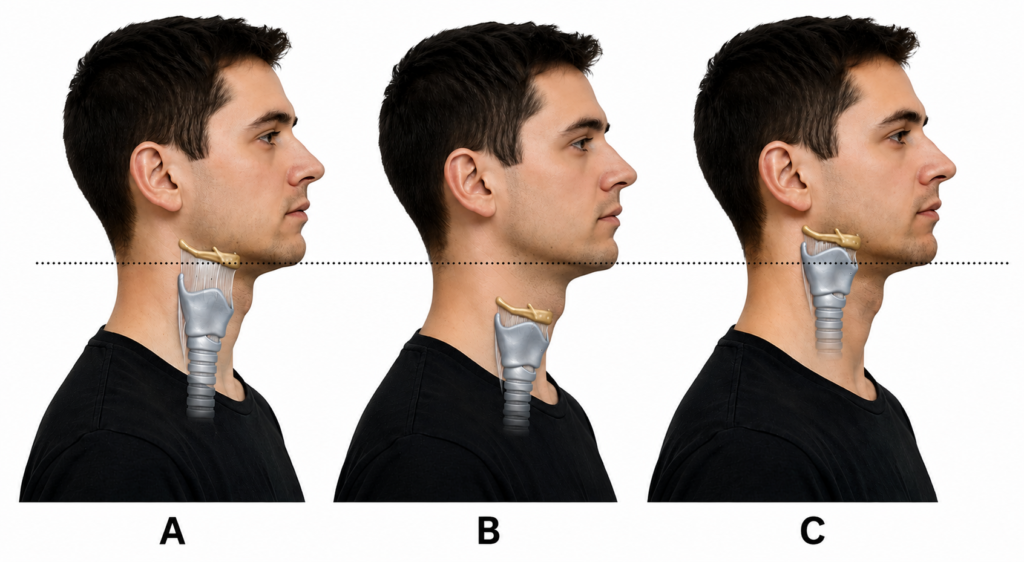
The hyoid bone is of fundamental importance because it is directly related to the tongue and functions, in a sense, as its base. Therefore, the position of the hyoid significantly influences the height and overall position of the tongue.
At the same time, the space and relationship between the hyoid bone and the larynx are also important. These structures do not function in isolation: the position of one influences the other, and together they form part of the overall configuration of our vocal apparatus.
In the three examples in the image—which are slightly exaggerated to make the differences easier to observe—we can see three distinct configurations.
We can observe three positions of the larynx: in example A, we see a configuration with a good opening; we would say that this position corresponds to what we call an “open throat”; however, in examples B and C, we see a position we’d call “voice in the throat,” with different qualities between the two due to their height—one brighter and shrill, the other thicker—giving the singer the false perception of a darkness and fullness that only he hears.
We can combine examples A, B, and C in many ways to achieve different configurations, and that is what we’ll actually see when working with different voices. The intention here is simply to begin understanding an important principle: the position of the structures in our vocal apparatus has direct consequences on the way our voice functions.
The extrinsic muscles of the voice play a fundamental role in this organization, as they influence the position of structures such as the larynx and the hyoid bone. In order for the intrinsic muscles of the larynx—which are responsible for many of the most precise adjustments in vocal production—to work efficiently, they need a certain degree of freedom, organization, and flexibility in the structures surrounding them.
There is also something important we must keep in mind when observing these examples. In men, the larynx can be clearly visible from the outside. The hyoid bone, on the other hand, is not visible. We can feel it with our fingers, but directly observing its position while we sing is practically impossible.
This is especially interesting when we consider that the hyoid bone is unique within our skeleton: it is not directly connected to any other bone. It is suspended and supported by various muscle groups, including the suprahyoid and infrahyoid muscles.
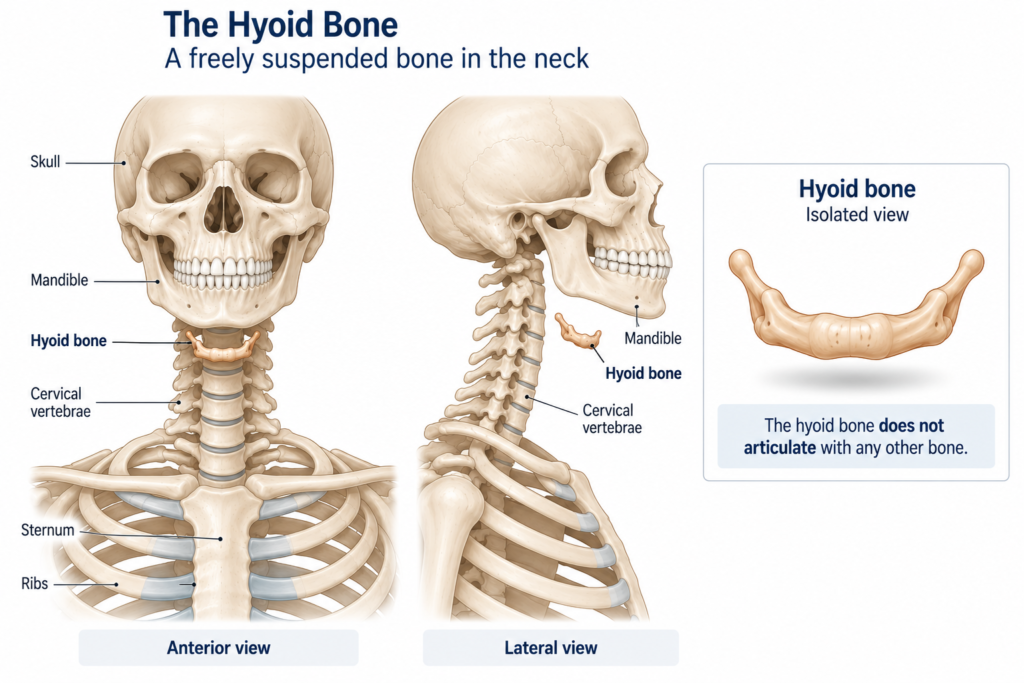
Therefore, its position does not depend on a fixed bony structure, but rather on the balance between the muscular forces acting upon it. Depending on which muscles are more active or dominant relative to their antagonists, the position of the hyoid bone can change.
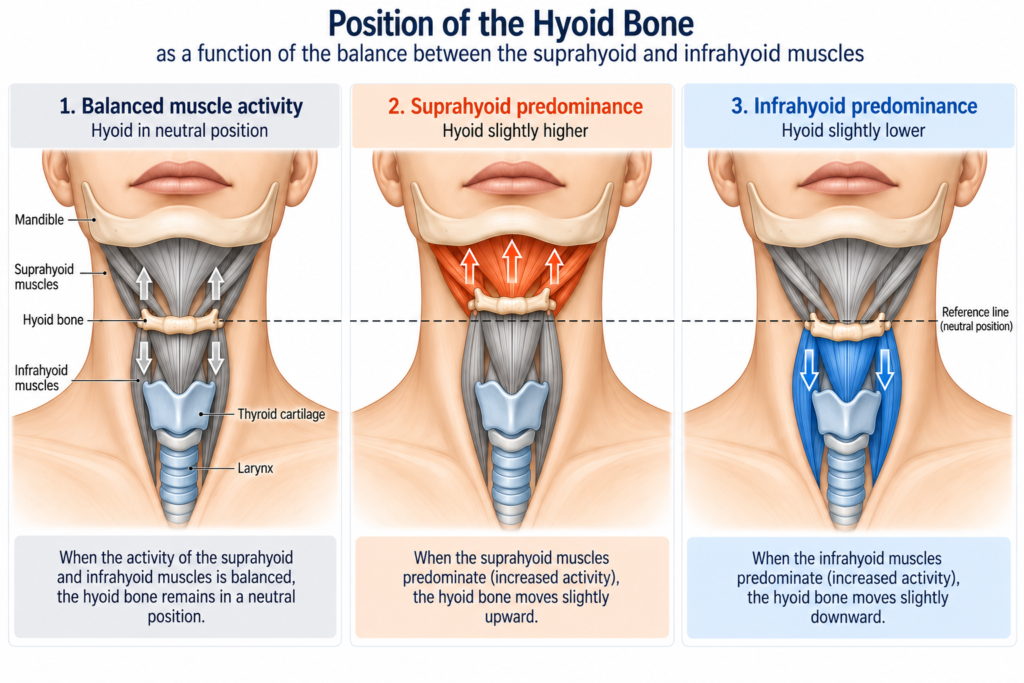
And, because the larynx is connected to the hyoid bone, the positions of both structures are inevitably related.
This is just one example of what I mean by position and flexibility. In order to work precisely on our voice, we first need to understand that our instrument is not a fixed structure. Its position is constantly changing as a result of the interaction between different muscles and structures.
And so that we can develop a flexible, efficient voice capable of responding to different demands, we need that structure to allow for movement and adaptation, rather than forcing us to constantly compensate with tension.
Coordination
The second variable has to do with our coordination.
I’m referring to the precision and dexterity with which we’re able to coordinate the different muscles involved in voice production. But it also has to do with our ability to learn, control, and modify those movements.
In a sense, coordination relates to the fineness of our motor system. It’s not just about being able to perform a movement, but about how precisely we can do it, how much control we have over it, and to what extent we’re able to modify it to achieve different results.
We can all sing, but not everyone masters their voice in the same way
Just as most people can learn to ride a bike, most can also learn to sing.
The basic coordination required for singing isn’t necessarily anything extraordinarily complex. We can learn to produce sounds, hold a note, follow a simple melody, or sing a song without needing exceptional ability.
However, this is where the first variable comes into play again: posture and flexibility.
In some cases, a person may feel that they simply “can’t sing.” They may have difficulty holding a pitch, reproducing a melody, or performing certain vocal movements, even when they fully understand what is being asked of them.
The problem isn’t always an inability to learn or coordinate a movement. Sometimes, the position of the vocal apparatus is so far from the required configuration that such coordination simply cannot occur easily.
This would be comparable to asking someone to perform a ballet move for which they do not yet have the necessary flexibility. They may perfectly understand what movement they need to make and even know how they should do it, but if their body cannot yet reach that position, they simply won’t be able to perform it.
Something similar happens with the voice.
The greater the demands we place on the instrument, the greater the skills we need to develop. Singing a simple song is not the same as trying to master a voice with the range, amplitude, freedom, and flexibility necessary to meet much greater demands—for example, those of an aria.
Here we can return to the example of the bicycle.
It’s one thing to learn to ride a bike to get from one place to another. It’s quite another to master it with the precision of an acrobat capable of performing extremely difficult maneuvers.
We can all learn to ride a bicycle, but the level of mastery depends as much on natural coordination as on the time we devote to practicing.
Exactly the same thing applies to the voice.
That’s why, although posture and flexibility and coordination are deeply related, to me they represent different things.
The first variable has more to do with the quality and potential of the instrument we’ve built. The second has to do with our ability to use that instrument.
Coordination as a Tool for Musicality
This is where coordination becomes especially important from a musical standpoint.
For me, coordination is, in a way, the bridge between a musical idea and its physical realization.
We may have a very clear idea of how we want to interpret a phrase. We can imagine where we want to create tension, where we want to resolve it, which word we want to emphasize, how we want to connect two notes, how we want to execute a legato, or even what kind of tone color we want to use at a given moment.
But having that idea in our mind doesn’t necessarily mean we’re able to carry it out.
To do so, our motor system must be able to translate that musical intention into extremely precise movements.
And the greater our coordination, the greater our ability to control all those small details.
This is one of the reasons why a singer can be musically extraordinary even if, from a purely aesthetic standpoint, they do not possess a particularly beautiful voice.
Let’s try a little mental exercise: imagine isolating a single sound from a performance. A vowel, for example. If we could hear it completely separate from the rest, analyze its production, and judge it solely on the basis of its sound emission beauty, we might discover that that sound, on its own, does not strike us as particularly appealing. It might even seem harsh, unpleasant, or simply ugly.
And yet, when we listen to the complete performance, that may no longer be what captures our attention.
What begins to take on greater importance is the way that singer constructs their musical discourse: how they phrase, how they execute their legatos, how they articulate, and how they use rhythm, dynamics, accents, and intention.
When all these elements are used with exceptional coordination, the musicality can become so powerful that the beauty of the sound recedes into the background.
This does not mean that an ugly sound magically becomes beautiful, nor that the quality of the vocal production ceases to matter. It means that, in a performance, great coordination and musicality can cause our attention to focus on the overall expression rather than on the vocal production itself.
That is where, coordination becomes one of the main tools of musicality.
A singer with highly developed coordination can communicate remarkably much, even with a relatively limited voice.
They may have a narrower range and less variety of timbres due to poor vocal production. And yet, they can use the resources they have with such precision that they manage to create an extraordinary performance.
They can achieve a great deal with relatively few resources.
But the quality of the vocal production itself also communicates.
However, here we see the other side of this relationship
Coordination and musicality are not the only things capable of conveying meaning.
There is also the possibility that the quality of the sound itself possesses, in and of itself, enormous expressive power.
Consider, for example, the final sound of a performance. A singer may reach a note and produce a sound of such extraordinary quality, amplitude, harmonic richness, or beauty that that single moment is capable of eliciting a very intense emotional reaction.
In that case, we do not necessarily need a complex phrase or a great deal of musical information to feel the impact of what we are hearing.
Sometimes, a single sound can convey more than an entire perfectly constructed phrase.
And there we can see once again the importance of the first variable.
The quality, possibilities and development of the instrument also hold enormous expressive value. A voice with great range, a richness of timbre, freedom, and sound possibilities possesses a much broader palette with which to communicate.
Of course, one thing does not exclude the other.
The most complete result would be to develop both variables: to build a superior instrument and, at the same time, to develop the coordination necessary to use that instrument to its fullest potential.
But in reality, these qualities can develop in very different proportions.
One person may have an extraordinary instrument and still not know how to use it to its full musical potential. Another may have a more limited instrument, but such highly developed coordination and musicality that they are capable of conveying something extraordinary.
That is why it is useful to consider these two variables separately.
The higher the quality of our instrument, the more resources we will have at our disposal.
But the better our coordination, the better we can utilize the resources we have.
And, depending on how these two variables are developed, we may encounter very different voices: voices with an extraordinary instrument but one that is still not fully mastered, voices that are technically more limited but musically fascinating, or, in the best-case scenario, voices in which great instrumental quality and extraordinary coordination work together.
That balance between what our instrument is capable of offering and the way we are able to use it, is one of the keys to understanding the enormous differences we can find between one voice and another.
Training
The third and final variable is, quite simply, training.
Training consists of repeating and practicing the coordination we wish to develop, until our body is able to perform them with ever-greater precision and with less conscious effort.
At first, when we learn a new coordination, we usually have to think about what we’re doing. We have to pay attention to the movement, try to reproduce it, and correct it when something isn’t working. With repetition, our motor system gradually begins to recognize and master that coordination, until we can perform it much more automatically.
This is especially important in singing because, while we sing, we cannot consciously think about every muscle involved in voice production. We need many of these coordinations to be sufficiently trained so that we can use them without having to control each movement individually.
That’s why, no matter how favorable our position may be or how good our natural coordination skills are, if we want to develop our voice and take it further, we need to train.
And, on the other hand, we shouldn’t think that posture and coordination are completely fixed qualities that we’re simply born with.
A person may not initially have a particularly favorable posture or a great natural ability to coordinate their voice. However, both of these can be developed and improved through proper practice.
Through training, we can gradually modify our movement patterns, develop greater flexibility, and learn coordination that at first seemed impossible or extremely difficult.
Of course, there are natural differences among people. Some may start with certain advantages: a greater ease in coordinating movements, a voice that responds easily, or a physical build that initially allows them to produce certain results with less difficulty.
But those initial advantages do not necessarily determine how far a person can go.
Someone who starts out with less natural aptitude but understands what they’re doing, trains properly, and maintains discipline for years, can go much further than someone with great natural gifts who never learns to develop them.
“Talent may determine where we start. Training, on the other hand, has an enormous influence on how far we can go“
A Model for Analyzing the Voice
These three variables—position and flexibility, coordination, and training—form the model I propose for analyzing the voice.
The idea is not to use it simply to decide whether a voice is good or bad, nor to classify it according to a particular genre or a specific aesthetic ideal.
A voice can belong to any style, and even so, we can observe these three variables.
We can ask ourselves, for example:
- How favorable is the position, and what degree of flexibility does the instrument have?
- How precise is the coordination with which that person controls and uses their voice?
- How well developed are those abilities through training?
By observing a voice from these three perspectives, we can begin to understand not only how it sounds, but also why it sounds that way.
A voice may have excellent sound quality but limited coordination. It may have extraordinary coordination and great musical ability but a more limited instrument in terms of range, color, or intensity. Or it may have enormous potential in both areas but not have developed it sufficiently due to a lack of training.
We may also encounter issues that do not pertain solely to one of the three variables. A limitation in position can hinder coordination. Poor coordination can create compensations that affect flexibility. And a lack of training can prevent coordination that we have already established from becoming fully consolidated.
Therefore, these variables do not function completely independently. They are constantly interrelated.
However, separating them allows us to analyze more clearly what is happening.
Instead of limiting our analysis to saying that a person has a “beautiful,” “ugly,” “good,” or “bad” voice, we can try to identify which elements are producing that result.
We can observe how developed the vocal instrument is, how well the person is able to use it, and how much of that potential has been consolidated through training.
And that is precisely where this model becomes useful to me: it does not aim to define how a voice should sound.
It aims to give us a way to observe it, understand it, and work on it.
Because, regardless of musical style or the particular characteristics of each singer, we are always working with an instrument that requires a certain posture and flexibility, an ability to coordinate in order to turn an intention into sound, and a process of training to develop and consolidate both.
Returning to the question we started with: Are we born with a good voice, or do we develop it?
The answer is that we are not born with a fully formed voice; we are born, if anything, with a starting configuration. To think that singing is a genetic privilege reserved for a select few is to ignore the very nature of the vocal instrument. The voice is not a static condition that one is either born with or without: it is a living, malleable system in constant evolution. Genetics or natural ability only determine the “snapshot” on day one; the interaction between position, coordination, and training is what writes the rest of the story.
“Talent is not the destiny of a voice, but merely its starting point. The voice is not something you’re born with: it’s something you build”